Table of Contents
- Knowledge Base
- Cleaning Tools
- Navigating EPA-Registered Sporicidal Agents for Cleanrooms in Healthcare Facilities: What You Need to Know
 Contec Healthcare
 Compounding Pharmacy, Article
Navigating EPA-Registered Sporicidal Agents for Cleanrooms in Healthcare Facilities: What You Need to Know
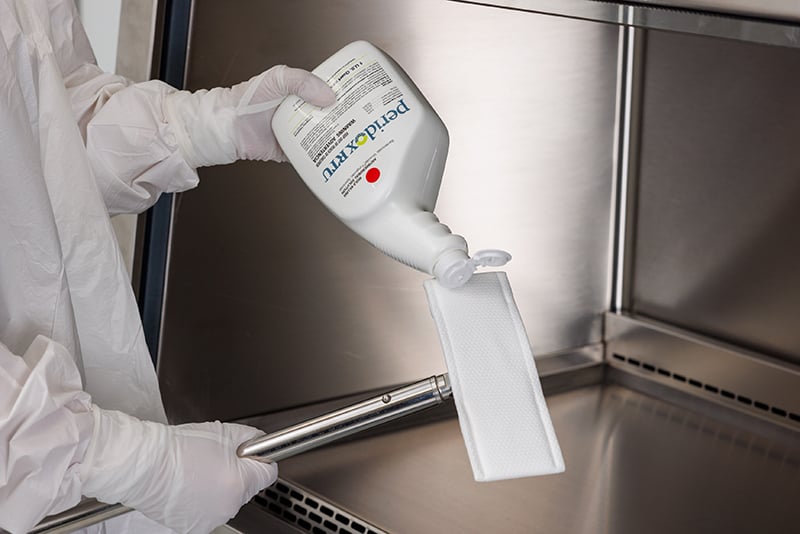
Maintaining a sterile environment in healthcare cleanrooms — particularly for sterile compounding and outsourcing (503b) facilities — requires effective sporicidal agents to control spores and resistant organisms. However, confusion exists over which EPA-registered sporicidal agents are appropriate for controlled environments and cleanrooms, creating a need for clearer guidance.
What Are EPA-Registered Sporicidal Agents?
An EPA-registered sporicidal agent is a chemical disinfectant that the U.S. Environmental Protection Agency has evaluated and approved for its ability to kill or eliminate spores — hardy forms of microorganisms that resist traditional disinfectants. These are critical for environments where microbial contamination must be tightly controlled.
Why are spores a concern in cleanrooms?
Spores are among the most resistant forms of microorganisms. In sterile compounding and other controlled settings, failing to inactivate spores can lead to contamination risks that compromise product safety and patient outcomes. EPA registration helps validate the sporicidal efficacy of disinfectants for these high-stakes environments.
What types of healthcare environments are affected?
Sterile compounding spaces and 503b outsourcing facilities prepare medications that must be free from contamination. Maintaining cleanrooms that control particulate and microbial bioburden is vital to protecting patient safety and ensuring regulatory compliance.
Who are the key decision-makers impacted?
Pharmacy directors, sterile compounders, 503b facility personnel, pharmacy technicians, and cleanroom managers all need clear guidance to choose and implement appropriate sporicidal cleaning agents as part of their contamination control programs.
Why is there uncertainty about sporicidal agents?
As standards and regulatory expectations evolve, confusion has grown about which EPA-registered sporicidal agents are suitable for controlled environments and cleanrooms. This makes selecting the right products — based on validated sporicidal claims and appropriate use conditions — challenging for facility managers.
What’s the risk of choosing the wrong agent?
Using disinfectants or sporicides that are not validated for cleanroom use can result in inadequate spore kill, poor contamination control, and potential non-compliance with facility standards or USP expectations — all of which can impact patient safety and regulatory adherence.
Key Takeaways
- EPA-registered sporicidal agents are validated by the EPA for their ability to kill microbial spores — essential in cleanroom contamination control.
- Sterile compounding and 503b facilities face specific challenges in maintaining sterile environments that require effective sporicidal use.
- Confusion exists among decision-makers about which agents are appropriate for controlled environments and cleanrooms.
- Contec Healthcare offers educational support, research, and tailored resources to help clarify choices and support compliance.
What resources does Contec Healthcare offer?
Contec Healthcare provides research, educational support, and consultation to help healthcare facilities make informed decisions about sporicidal agents. Available resources include in-service training, webinars, customized documents, and expert guidance tailored to facility needs.
By partnering with a Contec Healthcare specialist team familiar with cleanroom requirements and EPA-registered sporicides, facility managers can better select appropriate products, understand regulatory expectations, and maintain effective contamination control practices.
 return to overview
 back to top