Contamination Control: Core Elements
The presenter outlines five key elements of contamination control:
- Engineering controls (design, use, maintenance)
- Hand hygiene and garbing
- Material handling
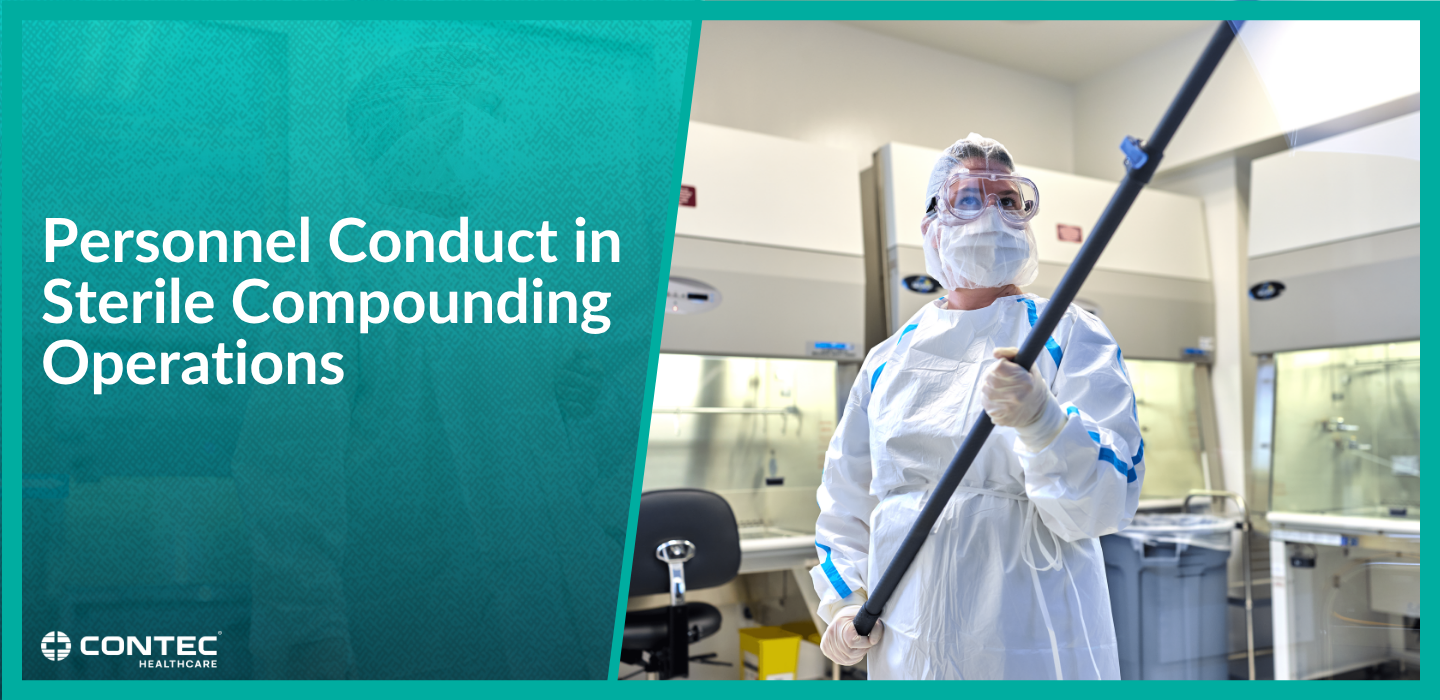
- Personnel conduct
- Aseptic technique
These elements are interconnected, and failures in one area can impact overall contamination control.
USP <797> Updates on Personnel Conduct
Historically, USP <797> provided little guidance on personnel conduct. However, the 2023 revision introduces expectations that:
- Personnel must maintain proper conduct
- Competency must be developed and maintained
- Movement of personnel and materials must be controlled
Despite this, the chapter still does not define specific acceptable or unacceptable behaviors.
Lack of Specificity in Regulatory Guidance
A key challenge is that USP <797> requires proper conduct but does not explicitly define it.
This leaves facilities responsible for:
- Interpreting expectations
- Developing internal policies
- Training staff on appropriate behaviors
The lack of specificity makes best practice guidance essential.
Defining Conduct Through Best Practices
Because regulatory language is broad, the presenter emphasizes using the following to define appropriate conduct in cleanroom environments:
- Industry experience
- Research
- Manufacturing standards
- Common sense
Facilities must translate general expectations into specific, actionable behaviors.
The Human Factor in Contamination Risk
Personnel are identified as a major source of contamination.
Improper conduct can lead to:
- Increased particle generation
- Airflow disruption
- Introduction of contaminants
Even with proper engineering controls, human behavior significantly impacts environmental control.
Conduct Begins Outside the Cleanroom
The session highlights that proper conduct starts before entering the cleanroom.
Factors include:
- Personal hygiene
- Health status
- Physical condition
Personnel must be mindful of their overall condition, as it can affect contamination risk once inside controlled environments.
Movement and Behavior in Controlled Environments
Conduct within the cleanroom includes:
- Controlled and deliberate movement
- Awareness of airflow patterns
- Minimizing unnecessary activity
- Proper positioning during compounding
Movement of both personnel and materials must be carefully managed to maintain environmental integrity.
Building a Culture of Proper Conduct
The webinar emphasizes creating a culture where proper conduct is understood, practiced, and reinforced.
This includes:
- Ongoing training and competency development
- Clear SOPs defining expected behavior
- Reinforcement of contamination control principles
Facilities must go beyond compliance and actively promote disciplined behavior.
 Contec Healthcare
 Compounding Pharmacy, Staffing and Training, Webinar

 return to overview
 back to top